Europe's great medieval walled city is still lived in, still busy and still full of surprises. Here is how to see the best of Rhodes Old Town in a day.
There are old towns, and then there is Rhodes Old Town. Surrounded by around 4 km of massive medieval walls, this is where the Knights of Saint John ruled for two centuries, where the Ottomans lived for four more, and where the Italians left their mark in the twentieth century. It is a UNESCO World Heritage Site and one of the best-preserved medieval towns in Europe. It is also a real neighbourhood, with families, bakeries, cats and washing lines.
This guide covers what to see, how to walk it and how to avoid the crowds, whether you are staying in town or visiting on a day trip from Lindos.
A very short history
The Knights of Saint John, a military religious order, took Rhodes in the early fourteenth century and turned its capital into a fortress. They held it until 1522, when Suleiman the Magnificent took the city after a long siege. The Ottomans ruled Rhodes until 1912, followed by the Italians, who restored, and sometimes reinvented, many of the medieval buildings. Rhodes joined Greece in 1948.
All of those layers are visible as you walk: Gothic inns, minarets, Byzantine churches and Italian-era restorations, often on the same street.
The main sights
The Palace of the Grand Master
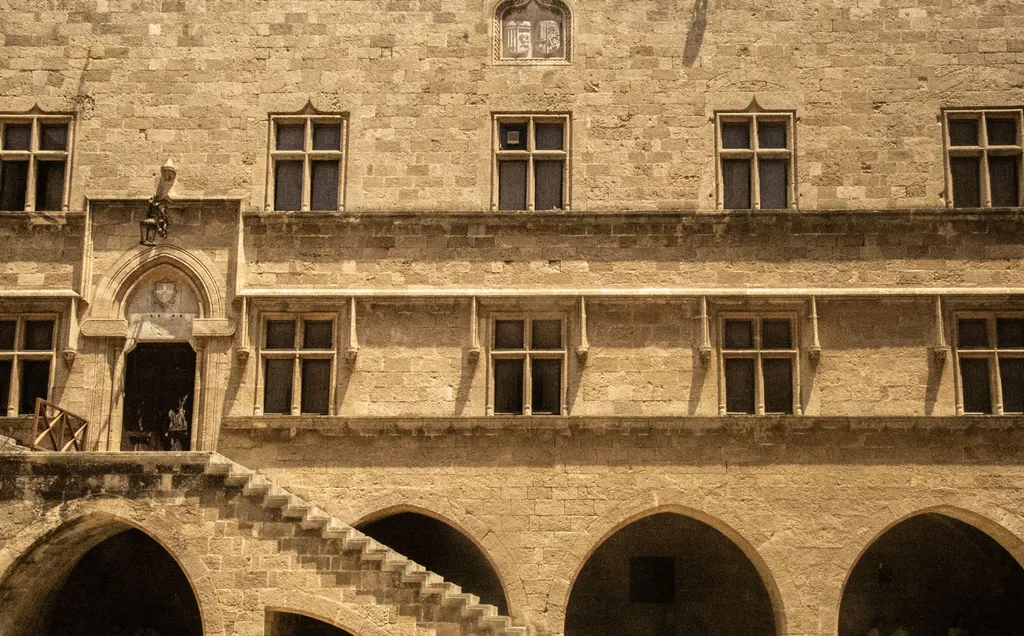
The imposing fortress-palace at the top of the Old Town was the seat of the Knights’ Grand Master. It was largely destroyed by an explosion in the nineteenth century and rebuilt by the Italians in the 1930s, so what you see is part medieval and part reconstruction. Inside are grand halls, courtyards and fine ancient floor mosaics brought from the nearby island of Kos.
The Street of the Knights
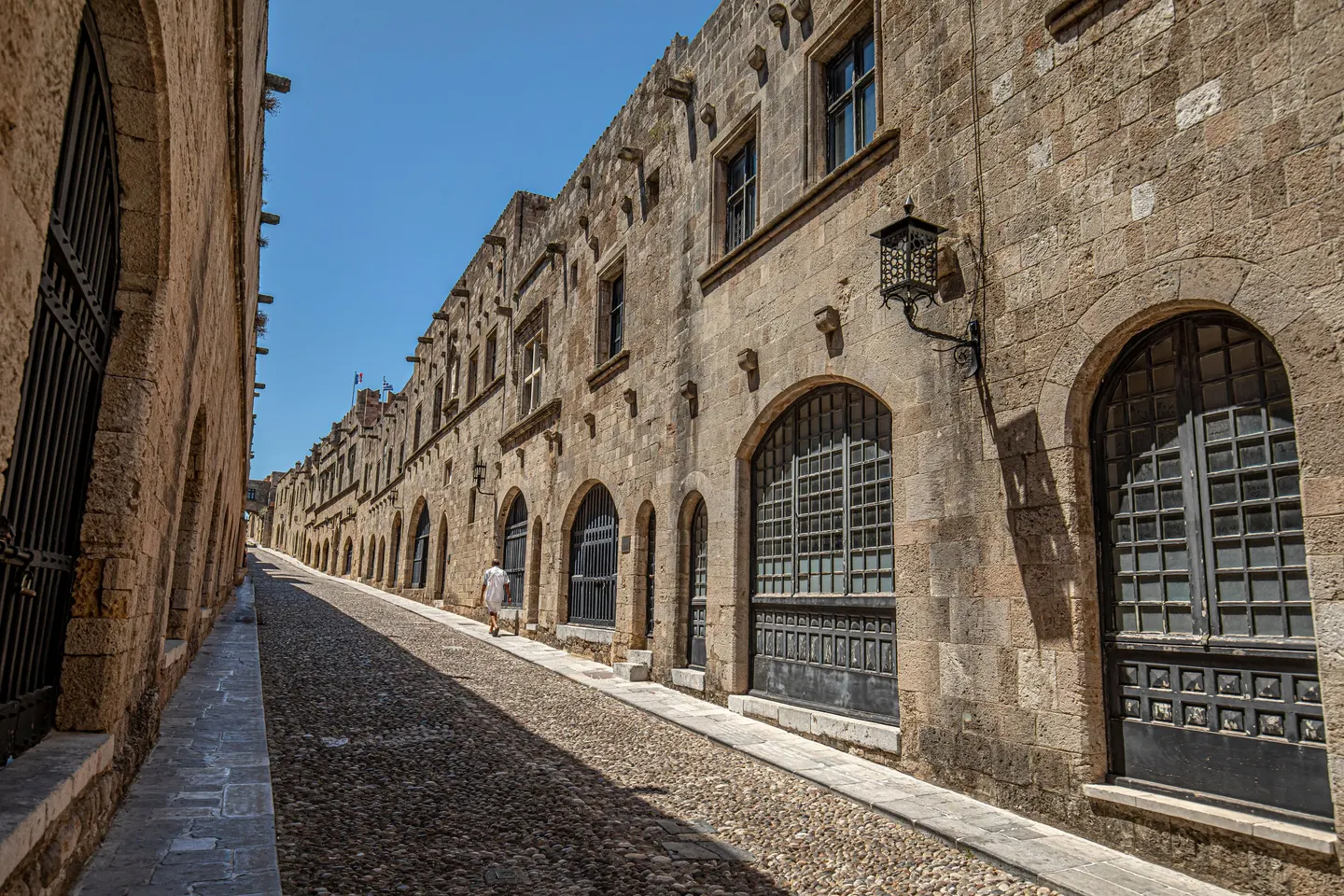
Running downhill from the palace, the Street of the Knights (Ippoton) is one of the most complete medieval streets in Europe. It is lined with the inns where knights of each nationality, or “tongue”, of the Order lived, their facades still carrying coats of arms. It is beautiful at any time, but magical in the evening when the lamps come on and it empties.
The Archaeological Museum
At the bottom of the Street of the Knights, the fifteenth-century Hospital of the Knights now houses the Archaeological Museum. The building itself, with its arcaded courtyard and great infirmary hall, is as impressive as the collection of statues, grave reliefs and finds from across the island.
The walls and the moat
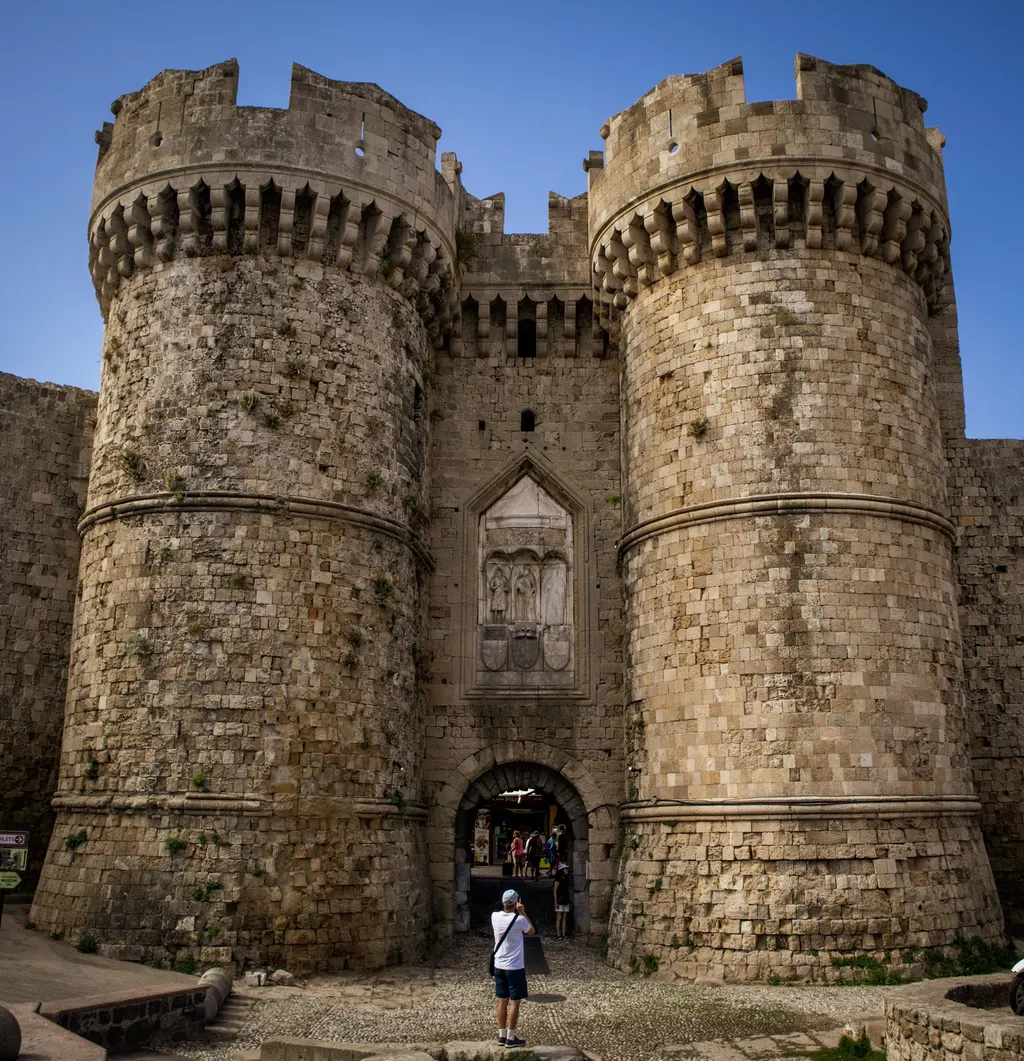
The fortifications are the Old Town’s defining feature. You can walk parts of the dry moat, a peaceful green path around the outside of the walls that shows just how massive the defences are. Access to the top of the walls is more limited, so check locally if you want to walk the ramparts.
Sokratous Street and Hippocrates Square
The Old Town’s main commercial street runs downhill from the pink-domed Mosque of Suleiman towards Hippocrates Square, with its fountain and cafés. It is busy, a little touristy and full of life. Duck into the side streets for quieter lanes and neighbourhood tavernas.
The Jewish Quarter
In the eastern part of the Old Town, the Jewish Quarter centres on the Square of the Jewish Martyrs, a memorial to the community deported in 1944. Nearby, the Kahal Shalom Synagogue, founded in the sixteenth century, is the oldest synagogue in Greece and has a small, moving museum.
The Clock Tower
For a view over the rooftops, minarets and domes of the Old Town, climb the Clock Tower near the Mosque of Suleiman. It is a short climb with one of the best panoramas in the city.
A one-day walking route
If you only have a day, this route takes in the highlights in a sensible order and saves the best atmosphere for the evening:
- Morning: enter through one of the northern gates and start at the Palace of the Grand Master when it opens, before the groups arrive.
- Walk down the Street of the Knights to the Archaeological Museum.
- Late morning: head into the Jewish Quarter and the Kahal Shalom Synagogue, away from the busiest streets.
- Lunch in a small square in the residential lanes, then a slow afternoon: coffee in Hippocrates Square, a look at the Mosque of Suleiman, the view from the Clock Tower.
- Late afternoon: walk the moat path around the outside of the walls as the heat drops.
- Evening: back inside for dinner, and one last walk up the lamp-lit Street of the Knights.
Just outside the walls: Mandraki harbour
A few minutes’ walk from the walls, Mandraki is the old harbour, guarded by the bronze deer statues at its entrance, a row of old windmills and the fort of Saint Nicholas. This is where many day-trip boats leave from, and a lovely place for an early-evening stroll.
Tips for visiting Rhodes Old Town
- Go early or late. The main streets are busiest from late morning to mid-afternoon, when cruise passengers and tour groups visit.
- Wear flat, grippy shoes. The pebbled lanes are uneven and polished smooth in places.
- Get lost on purpose. The quietest, prettiest corners are in the residential lanes away from Sokratous Street.
- Check opening days. Museums and monuments may close one day a week and keep shorter hours out of season.
- Stay for dinner. The Old Town changes character after dark, and many of its best tavernas are tucked into small squares.
Visiting from Lindos
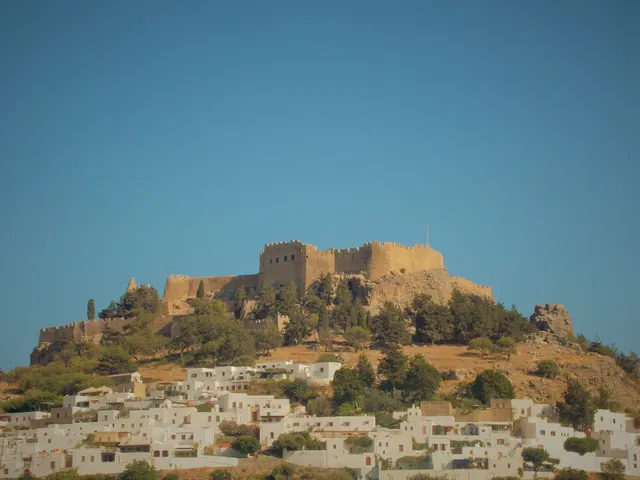
Rhodes Old Town is about 50 km from Lindos, roughly an hour by car or taxi and longer by bus. It makes an easy and rewarding day trip: leave after breakfast, spend the day inside the walls, have an early dinner and be back in the quiet of Lindos by night. Our guide to Lindos or Rhodes Town weighs up the two bases, and our day trips from Rhodes has more ideas.
If you would like the best of both, the Old Town by day and a peaceful village by night, Lindos Comfy Suites is a family-run, 21-suite hotel on the edge of Lindos. Our reception can book a driver for the day. See the suites and book direct at comfysuitesrhodes.com.
Frequently asked questions
How long do you need in Rhodes Old Town?
One full day is enough for the main sights: the Palace of the Grand Master, the Street of the Knights, the Archaeological Museum, the walls and the main squares. Stay into the evening if you can, when the lanes are at their most atmospheric.
Is Rhodes Old Town worth visiting?
Absolutely. It is a UNESCO World Heritage Site and one of the best-preserved medieval towns in Europe, and unlike many historic centres it is still a living neighbourhood with homes, shops and tavernas.
Can you drive into Rhodes Old Town?
Traffic inside the walls is restricted, and the lanes are narrow and cobbled. It is much easier to park outside the walls, or to arrive by bus or taxi, and explore on foot.
When is the best time to visit Rhodes Old Town?
Early morning and evening. In summer, cruise-ship passengers and tour groups crowd the main streets from late morning to mid-afternoon, and the midday heat on the stone is intense.